My neighbor Dave watched his backyard patio get ripped out last spring. Not because he wanted an upgrade—it was barely three years old. The concrete had spider-web cracks, one corner had sunk two inches, and water pooled against his foundation every time it rained. He told me, "I went with the cheapest bid, and now I’m paying for it twice." That’s the thing about patios around here. Carmel’s clay soil and wild freeze-thaw cycles punish shortcuts. If you’re after a new patio, you’re probably already Googling “patio installation cost Carmel Indiana” and wondering what’s fair. I’ll walk you through what things actually cost, what you get for your money, and how to not end up like Dave.
What a Patio Really Costs in Carmel (Hint: It’s Not Just Square Footage)
At first glance, you’ll see national averages that look too good to be true. Like, $6 a square foot for concrete? Maybe in Arizona. Here, a basic broom-finish concrete patio runs $8–$12 per square foot. Stamp it or color it, and you’re at $14–$22. Modular pavers—those interlocking bricks—fall between $18 and $28 a square foot. Fancy natural stone like bluestone or flagstone? That starts at $30 and goes north of $50. These numbers come from real quotes we’ve seen, and they include the stuff that matters: digging out that sticky Hamilton County clay, hauling it away, and bringing in clean aggregate that won’t turn to soup.
Now, a 12x16 patio (that’s 192 square feet) is a popular size. For that, a simple broom-finish concrete job might land around $1,700 to $2,300. Stamped concrete bumps it to $2,700–$4,200. Pavers for the same footprint? Somewhere between $3,500 and $5,400. Those are just the patios themselves, though. No steps, no fire pits, no fancy lighting. Add-ons tack on more, and site conditions can change everything (more on that in a sec).
Why Site Conditions Move the Price Needle
If your yard is wide open with good truck access, prices drift toward the lower end. Most Carmel lots aren’t that simple. Tight side yards where a mini skid steer barely fits? That’s extra labor. Old tree roots that need careful hand-digging? More time. And if you’ve got an existing slab or deck that has to be demolished and hauled off, factor in disposal fees and the occasional curse word from the crew. Our clay soils are another beast—they hold water and shift. A proper base here isn’t a suggestion; it’s the whole job. For pavers, we’re talking 6 to 8 inches of compacted gravel, then a bedding layer, and edge restraint so those bricks don’t wander over time. Concrete needs similar prep plus control joints and maybe reinforcement if you don’t want cracks running wild after the first winter.
Paver Patios vs. Stamped Concrete: Which Plays Nicer with Indiana Weather?
I’ve seen gorgeous stamped concrete jobs turn into a mess because nobody sealed them right, or they used rock salt one icy morning. But pavers have their own quirks. Here’s my opinion: if you want something that’s easier to fix down the road, go pavers. Individual bricks can be pulled up and replaced if they crack or stain. Freeze-thaw cycles make the ground heave, but a flexible paver surface moves with it—mostly. A concrete slab moves as one piece, so when it cracks, it cracks big. Stamped concrete gives you that seamless, stone-like look at a lower upfront cost than most paver projects, but you’ve got to stay on top of sealing (every two to three years) and be careful with ice melt. Calcium chloride instead of rock salt, please.
We did a project in WestClay last year where the homeowner was dead set on a stained concrete patio that looked like weathered wood planks. Gorgeous, but he didn’t realize his downspouts were dumping water right where the patio would go. We had to reroute those first—add about $300 for downspout extensions—or the whole thing would’ve been a wading pool. That’s where thinking like a landscaper helps. We’ll get to that.
Drainage Is Everything (And Usually the First Thing Overlooked)
You can’t talk about hardscaping in Carmel without talking about water. Code says you need a slope of at least 1/4 inch per foot away from the house, but plenty of patios fail because the base was too thin or nobody bothered to check for low spots. If your yard already gets soggy after a storm, a patio can make it worse unless you add integrated drainage. Channel drains at door thresholds, French drains along the edges, or grading adjustments might run $25–$45 per linear foot. It’s money well spent—way cheaper than fixing a foundation.
How We Build Patios That Last (And What IndyGreen Does Differently)
We’re not the cheapest. I’ll be straight with you. A quote from IndyGreen usually falls in the mid-to-upper range, and here’s why. We start with a site visit where we actually measure things, not just eyeball from the curb. We map out drainage, check for sprinkler lines (811 marks utilities, but those private irrigation pipes are on you), and talk through what you really want. No pressure, just a clear drawing and a line-item proposal so you can pick what fits your budget—maybe you skip the fire pit this year but add conduit under the patio for future lighting. That’s smart.
Our crews know this soil. They’ve dug in it a hundred times. They know that a paver base in Brookshire needs to be overbuilt because that clay holds water like a sponge. They know how to compact in lifts so you don’t get settling six months later. And they’ll leave your yard clean—plywood paths to protect the grass, everything graded smooth when they’re done.
When You Might Need a Tree Service Nudge
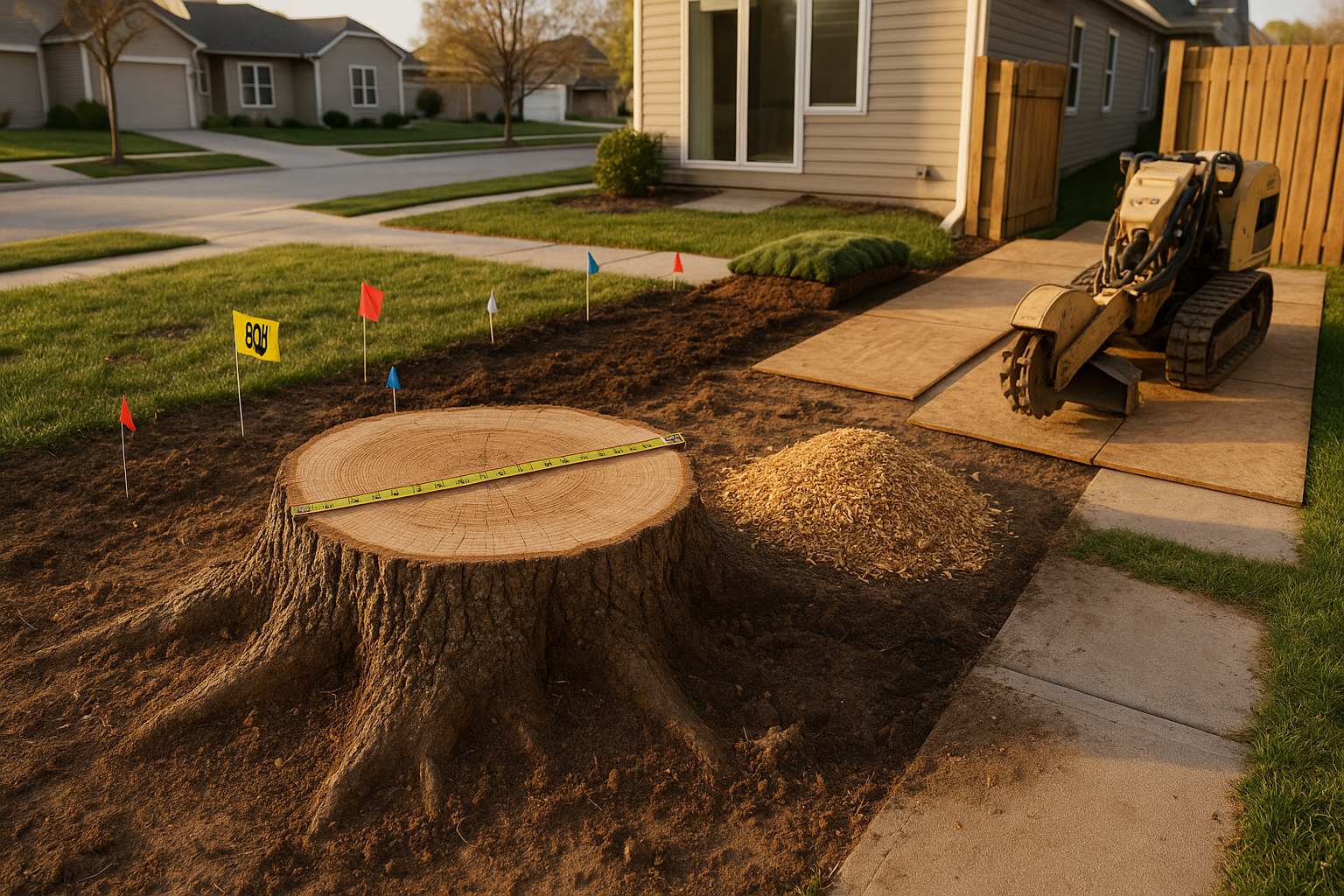
Here’s a story: a homeowner in Home Place wanted a patio under a big old maple. Beautiful shade, but those surface roots were everywhere. We could’ve tried to build over them, but that’s a guaranteed crack city. Instead, we had our tree service crew come out and do some careful root pruning (and eventually remove the tree, because it wasn’t healthy anyway—here’s how to spot that). The point is, patios and trees don’t always mix. Sometimes you need a landscaper’s eye to work around them, and sometimes you need a tree guy to open up the space. We handle both, so it’s one less headache.
Concrete Work Done Right, Not Quick
When we pour concrete around here, we don’t cut corners. That means a 4-inch slab on 4 more inches of compacted gravel, rebar or wire mesh where needed, and control joints cut within a day so cracks happen where you don’t see them. For stamped concrete, we use integral color and a release agent that won’t fade to pink in three years. And we’ll tell you up front: broom-finish is your low-maintenance friend. It’s not trendy, but it’s grippy when wet and holds up to snow shovels.
Handyman Touch-Ups That Tie It Together
A patio isn’t an island. Maybe the step down from your back door is rotting, or the handrail feels wobbly. Our handyman team can knock out those little fixes while the hardscape crew wraps up—new wooden step with a proper tread, or a fresh railing that meets code. It’s the stuff that keeps your project from feeling half-done. And if you’ve been meaning to replace that leaky hose bib near where the grill pad will go, that’s a handyman thing too. We find that people appreciate a single crew that can handle the full picture, not a parade of subcontractors. (That’s kind of our whole deal—read more about it here.)
The Boring Stuff: Permits, HOAs, and Timeline Reality
Most backyard patios in Carmel don’t need a building permit. The city’s Department of Community Services says you only need one if there are structures, electrical, gas lines, steps taller than 30 inches, or walls. But your HOA? That’s a different animal. Almost every HOA in places like the Village of WestClay or Brookshire requires an Architectural Review before you break ground. The process can take two to six weeks. We’ve seen designs get rejected because the patio color didn’t match the neighborhood “palette.” Plan early, or you’ll be the one hosting July 4th on an unfinished sand pit.
From signed contract to the first day of digging, expect a 2–6 week wait during the busy season (March through November). The actual install takes 1–4 days for most jobs, weather permitting. Spring brings rain delays, and the clay doesn’t compact well when it’s sopping wet, so we might have to pause. Fall is usually great—cool enough for crews to work fast, and you’ll have the patio ready for next summer.
Maintenance Stuff Nobody Talks About Until It’s Too Late
A sealed patio sheds water and looks good. Unsealed surfaces get stained, and pavers shift when the polymeric sand washes out. We recommend sealing concrete every 2–3 years and refreshing the sand between pavers around the same interval. Use calcium chloride ice melt on decorative concrete, never rock salt. And if you’re a “let the snow sit” kind of person, that’s actually fine for the patio—the danger is from the freeze-thaw cycling underneath, not the weight of snow on top.
So, What’s Your Next Move?
You’ve got numbers in your head now. You know what to ask about base depth, drainage, and HOAs. If you want a patio that doesn’t end up like Dave’s—cracked, heaving, and a cautionary tale—come talk to us. Not because we’re pushy, but because we’ll sit down and draw out exactly what you need. No surprises. Fill out the quote form on our site and we’ll schedule a walk-through. Bring your ideas, maybe some Pinterest pics, and we’ll give you a real number you can budget around. Even if you don’t go with us, you’ll know what a fair price looks like for your home in Carmel, Westfield, Fishers, or wherever you are in the neck of the woods.
Need one crew for the whole property?
Next-day irrigation and single-source landscaping, hardscape, tree, and handyman service across greater Indianapolis. Free estimates.