If you’ve ever walked across your lawn after a rainstorm and felt that squish-sponge feeling under your shoes — the one that soaks your socks even though the sun’s been out for two days — you’re not alone. A friend of mine over in Noblesville once told me she’d given up on the far corner of her backyard entirely. Every spring, it turned into a tiny lake. Mosquitoes loved it. Her dog loved it. She? Not so much. And that’s the thing about Indiana clay: it doesn’t let go of water easily. We’ll get into why, and more importantly, what you can actually do about it.
Why Indiana Clay Fights Back Against Drainage
Indiana soil, especially around Hamilton County, is mostly glacial till — heavy clay with tiny particles that stick together like cold peanut butter. Water just sits on top because the soil can’t absorb it fast enough. Add in the way builders scrape and compact ground around new homes in neighborhoods like Westfield or Fishers, and you’ve got a recipe for standing water that doesn’t move for days. Even a gentle slope doesn’t help much when the soil is packed tight and the rain keeps coming.
Spring here tends to throw a lot at us: snowmelt, storm after storm, and then summer downpours that hit hard and fast. If your yard’s got low spots — or worse, they’re right next to your foundation — you’ll see that water pooling every time. And it’s not just an eyesore. Mulch washes out, grass dies, and the mosquitoes throw a block party.
What a Drainage Problem Looks Like in Noblesville Yards
You might be dealing with clay drainage issues if: - There’s water standing in the yard more than 24–48 hours after rain. - The ground feels soft and spongy even when it hasn’t rained lately. - Your sump pump runs constantly, even on dry days. - You spot damp patches on foundation walls or notice a musty crawl space. - Side yards turn into muddy streams that kill your grass. - Water puddles near downspouts, or you see mulch floating away after a storm.
Some folks can’t even let their kids play outside after a light rain — the yard becomes a mud pit. And if you’ve got a patio or walkway, water might pool right where you walk, which is not only annoying but can also cause cracks and shifting over time. (That’s where a concrete contractor might point out that poor drainage shortens the life of your hardscapes — and they’d be right.)
Start With the Easy Fixes: Gutters, Downspouts, and Slopes
Before jumping to digging trenches, do a quick walk around your house. It’s amazing how often the real fix is simple — and cheap.
Check your gutters and downspouts. If they’re clogged, water overflows and dumps right at your foundation. Extend downspouts at least 6–10 feet away, using solid pipe (not that crinkly flex stuff that clogs fast). You can connect them to a pop-up emitter in the lawn — that’s a classic handyman project, and it’s worth getting right. A local handyman who knows how our clay behaves can make sure the pipe slopes correctly and won’t settle over time.
Look at the slope around your house. You want a drop of about 1–2% away from the foundation for at least the first 10 feet. If it’s flat or sloping toward the house, that’s trouble. Sometimes a landscaper can regrade just that section, building a gentle swale to steer water where it should go. A good landscaper will also know which plants and ground covers can handle wet clay without dying — and without causing new problems.
Do a little percolation test. Dig a hole about a foot deep, fill it with water, and see how long it takes to drain. If it’s still there the next day, your soil is slow, and you’re probably going to need more than just a downspout extension.
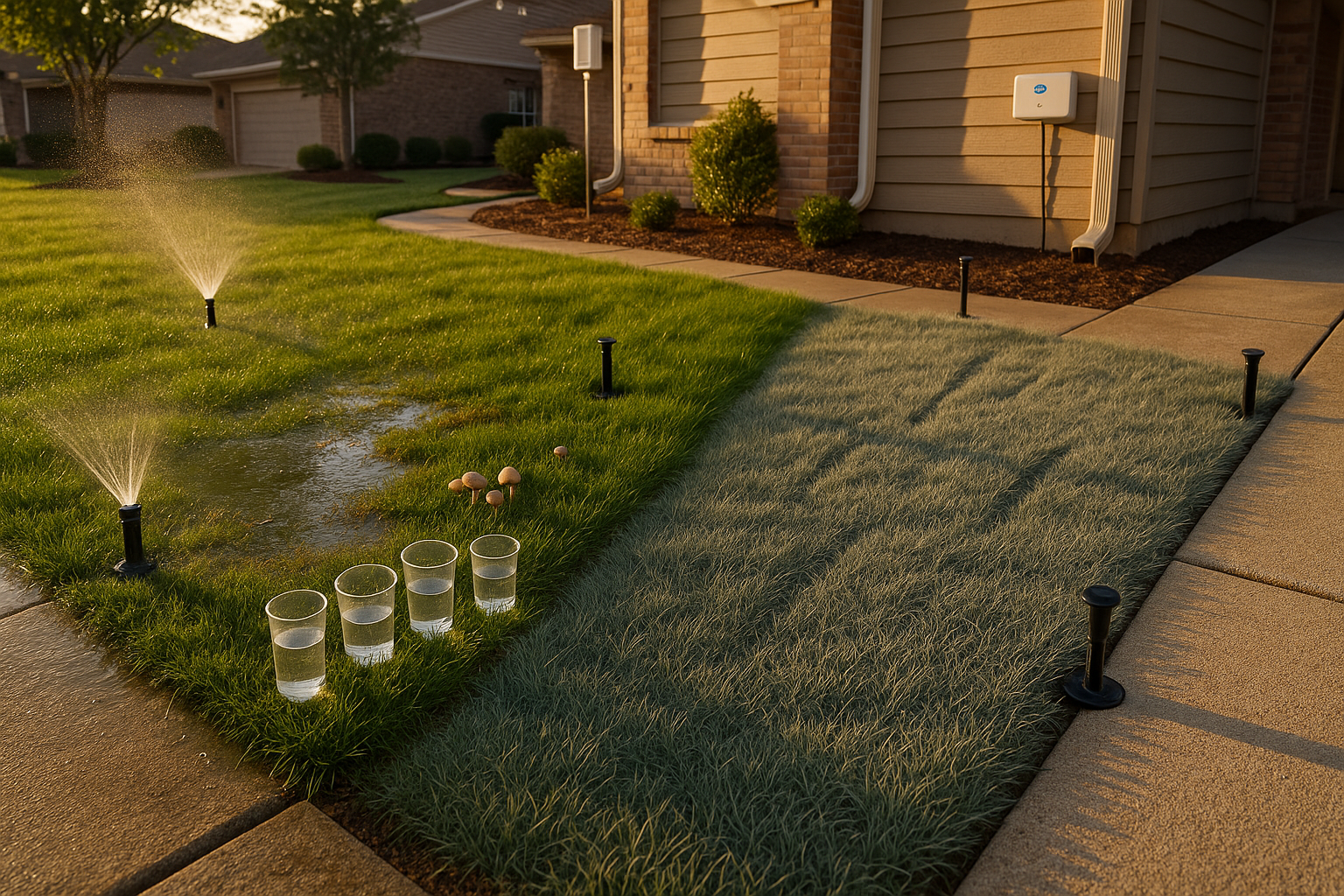
Rule out irrigation leaks. If you’ve got a sprinkler system, a broken line could be adding to the soggy mess. Turn it on zone by zone and look for unexplained wet spots. (If you’re digging later for drainage, remember to call 811 — and mark where your irrigation lines run. Even careful trenching can slice right through a sprinkler pipe.)
But Will a Simple Fix Really Work?
If your yard has a noticeable low spot where water ponds and it’s not about downspouts, then yes — grading that area or cutting a swale might do the job. A reputable landscaper can reshape the land so water flows to a better spot. I’ve seen that work beautifully in homes around Carmel and Zionsville, where side yards often funnel water between houses.
But if the water’s coming from the soil itself — like a high water table or an underground spring — you’ll likely need a subsurface fix. That’s when a French drain becomes the hero of the story.
The Right Way to Build a French Drain in Clay
There’s a lot of confusion about French drains. Some people think it’s just a trench filled with gravel and a pipe. But in heavy clay, doing it wrong means you’ll be digging the whole thing up again in two years.
Here’s the gold standard for our area: - Non-woven geotextile fabric lines the trench. This keeps our fine clay particles from mixing into the stone and clogging things up. - Washed #57 angular stone (not river rock) surrounds the pipe. The angular edges lock together and create stable voids for water to travel. - Perforated PVC pipe (like ASTM D2729 or SDR-35) with the holes facing down, laid on a bed of stone at a consistent slope. Corrugated pipe with a sock just doesn’t hold up in heavy clay — the sock clogs and the pipe flattens. - A solid pipe section carries the water from the perforated zone to the outlet. - Cleanouts at the start of the line and at any turns so you can flush the system.
This setup works because it intercepts groundwater and gives it a clear path out. It’s not magic — it’s just good hydraulics. When IndyGreen designs these, we always plan for an outlet that’s legal and won’t cause trouble down the road.
Where Does the Water Go?
That’s the big question. You’ve got to have an outlet. Unfortunately, you can’t just dump it onto your neighbor’s property (and they can’t dump it onto yours). Hamilton County and cities like Noblesville have stormwater rules, and many HOAs have drainage easements that require you to keep water flowing through certain paths.
Common outlet options: - Daylight to a lower area — if your property slopes toward a ditch, a creek, or even just a lower part of your own yard with good vegetation to slow the flow. - Pop-up emitter — works for gutter water in a lawn, but for a French drain it’s a last resort because it can freeze or clog. - Tie into an approved storm structure — some neighborhoods allow this, but you almost always need permission. Never, ever connect to a sanitary sewer. That’s illegal and causes bigger problems. - Dry well — a buried chamber that holds water and slowly releases it into the soil. In clay, a dry well alone often overflows, so it needs an overflow to daylight. Think of it as a temporary holding tank, not a permanent soakaway.
If you live near the White River or its tributaries in areas like northern Noblesville, pay attention to where the natural drainage paths go. Water always finds the lowest point. If you’re in a flood-prone backyard, grading and drainage improvements might need permitting — and a tree service might help you assess whether large trees are intercepting enough water or if root systems are actually displacing soil and making drainage worse. (Yes, tree roots can heave soil and create mini dams — another reason to bring in an expert eye.)
Sump Pump Discharge: Don’t Let It Sabotage Your Yard
If your sump pump dumps water right next to the house, you’ve got a problem that feeds itself. The pump runs to keep the basement dry, but the discharge saturates the ground and just filters right back down. Then the pump runs again. It’s a vicious cycle.
The fix: extend the discharge line far away, using a solid pipe with an air gap so it doesn’t freeze. In winter, that air gap is critical — frozen lines can crack or block flow, and then you’ve got water backing up into the basement. Some homeowners in Brownsburg or Avon route the discharge to a buried pop-up emitter in the lawn, and that works as long as it’s far enough out and not in a spot that turns into an ice rink in January.
Permeable Pavers and the Concrete Connection
If you’re already planning a new patio, walkway, or driveway, this is the perfect time to think about drainage. Traditional concrete slabs send all the rain straight off the edge, usually into the yard or toward the foundation. Permeable pavers, on the other hand, let water soak through the joints into a stone base below, which reduces runoff. In heavy clay, they need an underdrain to carry excess water away, but they’re a solid choice for managing water right where it falls.
A concrete contractor who understands Indiana soils can install a paver system that looks great and functions as part of your drainage plan. I’ve seen a home in Fishers where the driveway was actually sloping toward the garage — every rain, water piled at the door. They replaced it with permeable pavers and a channel drain across the garage entrance, and it’s been dry ever since. (Not all concrete contractors are drainage experts, though, so pairing that work with someone who knows both hardscapes and water management makes a big difference.)
What Happens After the Trenches Are Dug?
Nobody wants their yard looking like a war zone forever. That’s a fair worry. A good crew will cut sod carefully, set it aside during trenching, and replace it when they’re done. If the timing’s right — early fall or spring — they’ll overseed and add compost to help the soil recover. Clay benefits hugely from core aeration and compost topdressing over time, which gradually improves infiltration so that future rains don’t cause as much trouble.
If you’re getting work done in summer, sod can take hold with plenty of irrigation. But seeding is trickier in the heat. A landscaping team that handles restoration well will time the job so that you’re not staring at dirt for months.
Maintenance: Keep It Working Year After Year
Once your drainage is in, a little upkeep goes a long way. - Clean gutters a couple times a year. - Check pop-up emitters and catch basins for debris. - Flush French drain cleanouts with a hose to clear any silt. - Before winter, make sure outlets aren’t blocked and sump lines have an air gap. - Walk the yard after storms to see that water is following the paths you designed.
Let IndyGreen Help You Get This Right
We’re not about pushing the most expensive fix just because. When you call us for a drainage assessment in Noblesville, we start with your yard exactly as it sits. We measure elevations, map out flow paths, and figure out what’s actually causing the puddle — not just the symptom you see. We put together a clear plan with a materials list and a defined scope so you know what you’re paying for and why.
We also know the local rules. HOA drainage easements, 811 dig markings, stormwater discharge — we handle that so you don’t end up in a spat with the neighbors or the city. And we clean up after ourselves. No leftover gravel piles, no ruts from the equipment, no “that’ll grow back eventually.” We restore the lawn like it was our own.
If you’re tired of the squishy shoes and the mosquito convention in your backyard, let’s talk. Request an on-site drainage assessment, and we’ll give you a straightforward plan — no fluff, no games. We serve Noblesville and the whole metro area, including Indianapolis, Lawrence, Carmel, Fishers, Greenwood, Westfield, Zionsville, Brownsburg, Avon, and Plainfield.
You don’t have to just live with a wet yard. A little planning — and the right crew — makes Indiana clay a whole lot more manageable.
Need one crew for the whole property?
Next-day irrigation and single-source landscaping, hardscape, tree, and handyman service across greater Indianapolis. Free estimates.