My neighbor Jim stood ankle-deep in murky water last March, glaring at the brown lake that used to be his backyard. “Every spring,” he grumbled, “the rain comes and my yard turns into a swamp. My basement’s starting to smell like a wet sock.” Jim’s place is over in Avon, and like a lot of folks around here, his lot had settled over time, tilting just enough to guide every drop right toward his foundation. He’s not alone—compacted clay, freeze-thaw cycles, and those gully-washer storms we get in Central Indiana can turn even a nice lawn into a mess. The good news? You can fix yard grading drainage Indiana clay problems without draining your bank account or tearing up every inch of turf.
Figure Out Where the Water’s Coming From First
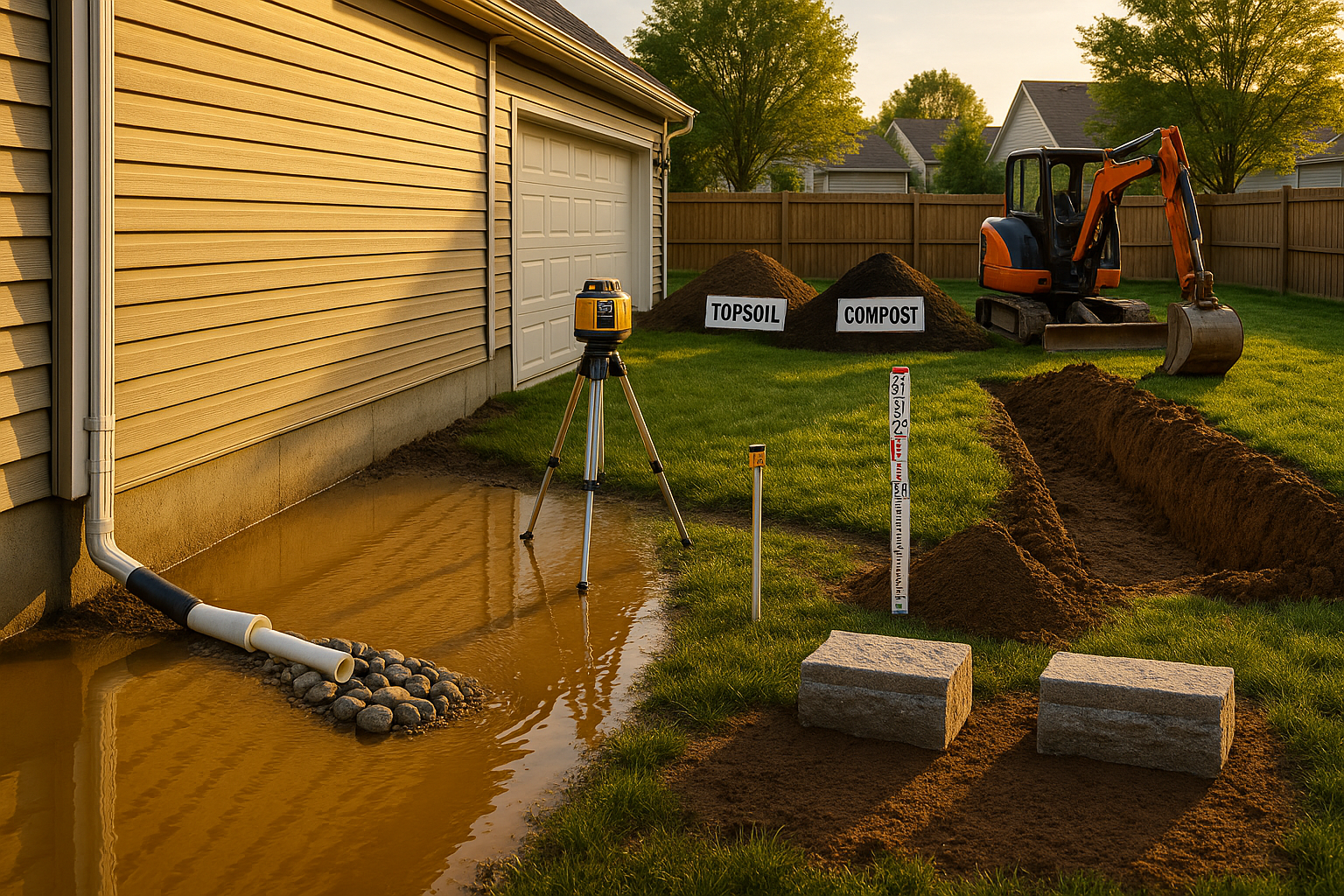
Before you do anything, take a slow walk around your place during the next heavy rain. Notice where puddles form, how water moves off the roof, and if it sheets toward the garage or pools against the foundation. Jim realized his biggest problem was a downspout dumping right next to the porch, plus a low spot by the fence where the soil had settled after the house was built. You don’t need fancy equipment—a string line and a line level from the hardware store can tell you a lot about slope. For drainage around foundations, the goal is a positive slope of about 2 percent (that’s a 1-inch drop every 4 feet) for at least the first 10 feet. In newer subdivisions like those in Brownsburg or Zionsville, final grades often miss that mark after backfill settles, so regrading becomes the fix.
Fixing the Grade: Not Just a Bunch of Dirt
If your yard slopes toward your house, you need to build it up around the foundation and shape swales to guide water away. I’ve seen too many homeowners just throw down a few bags of topsoil around the low spots—and that rarely works long-term because the clay underneath doesn’t let water through fast enough. Proper lawn regrading means stripping back the turf in key areas, bringing in screened topsoil mixed with a little compost, and compacting in lifts to avoid new settling. A landscaper who knows our clay soils will use a laser level to set the finished grade so water naturally finds a path to a safe outlet like a rear swale or a street curb. In Plainfield and Hendricks County, many lots share backyard swales—just make sure you don’t block the flow, and check your plat map for any drainage easements before you start reshaping things.
When Regrading Isn’t Enough: Swales, Trenches, and Dry Wells
Sometimes you can’t get enough slope across a flat yard. That’s where a shallow grass swale comes in—basically a gentle, vegetated channel that moves surface water to a better spot. Swales work well for sheet flow, especially in neighborhoods where your neighbors’ runoff naturally drains onto your property. But for spots that stay soggy even days after rain, you may need a subsurface fix. French drains—a trench filled with washed stone and a perforated pipe—can intercept groundwater and redirect it. We’ve had good results using non-woven geotextile fabric to keep that nasty Indiana clay from clogging the stone, and smooth-wall PVC instead of corrugated pipe. A dry well is another option, but only where the soil perks fast enough; in most of our yards, you’ll get a slow drain that just backs up during big storms. If you’ve got a spot where a tree’s roots tend to hold water, a tree service might advise on root health and whether lowering the grade would damage the tree—sometimes you have to work around big roots and choose a more creative drain path.
Downspouts: The First Line of Defense
Jim’s soggy basement rant? I told him to extend his downspouts underground with solid PVC pipe run at least 10 feet away, popping up in a sunny spot where water could sheet away. Those little splash blocks just dump water right against the clay, and corrugated pipe flattens out or fills with silt fast. A handyman can bury a downspout extension in an afternoon, but for anything that ties into a larger drain system or crosses utility lines, you’ll want a contractor who knows how to maintain a steady 1 percent fall and avoid dips. In winter, pop-up emitters can freeze, so we often switch to a “daylight” outlet that just drips onto a rocked splash pad—the discharge dissipates before it ices up. If you have a sump pump in your basement, route that discharge to the same kind of outlet, well away from the house and walkways. In some Fishers and Carmel homes, we tie sump lines into the main drain network so nothing dumps onto the lawn and creates another soggy patch.
Driveways, Patios, and Hardscapes: Don’t Let Them Become a Ramp for Water
Water that sheets off a concrete driveway or patio can head straight for your garage or basement door if the slope’s wrong. One Greenwood homeowner I met had a slab that settled slightly toward the house—every spring rain, water lapped at the garage floor. We cut in a trench drain (a channel drain) right at the apron and connected it to the site drainage plan. A concrete contractor can also saw-cut and replace a sunken section, or regrind the surface, but often just adding a channel drain and tying it into the overall system costs less and fixes the issue. If you have a retaining wall as part of your landscaping, keep an eye on its drainage—without proper weep holes and stone backfill, water builds up behind the wall and can push it out over time. Our blog on retaining wall costs in Fishers has more details on that whole setup.
Soil and Grass: Don’t Skip the Finish Work
Once you’ve got the heavy grading and pipes in place, the final step is getting grass to grow. Over our tight clay, spreading a few inches of quality topsoil blended with compost helps the turf establish and soak up light rains, but it’s no substitute for correct grading. Cool-season blends of tall fescue and Kentucky bluegrass (check out our guide to cool-season grass types) do well if seeded in fall or early spring. Cover new seed with straw or an erosion control blanket, especially on sloped areas, or you’ll watch your topsoil wash down the street in the next storm.
DIY or Hire? A Quick Gut Check
You can absolutely dig a downspout line or patch a low spot yourself if you’re comfortable with a shovel and can get the slope right. But regrading a whole yard or installing a French drain that crosses utility lines? That’s when you hire someone who breathes Indiana clay and carries a transit level. The handyman side of things—replacing a broken downspout, cleaning out catch basins, adjusting a pop-up emitter—saves you money on maintenance, but the large-scale stuff requires machine work, utility locating (always call 811), and an eye for where water will really go.
How We Approach a Yard Drainage Fix at IndyGreen
When a neighbor calls us after a rain, we walk the property together with a grade stick, mark the wet spots, and talk about where the water needs to end up. Then we map out a plan, itemize every line item—from the pipe and stone to the topsoil and seed—and hand you a fixed price. We keep the excavation neat, protect existing trees and irrigation lines, and restore the lawn as fast as the weather lets it root. No hidden fees, no surprise mud pits in your yard for weeks. If any permit questions come up (Plainfield has a simple stormwater compliance process for homeowners, and we guide you through it), we’ll flag that early. After the project, we check back after the first big storm to make sure the water is doing what we promised.
If your yard’s been holding water like a bowl, don’t wait for the next downpour to soak your foundation or turn your lawn into a marsh. Get a straightforward assessment and a plan that works for our clay—a real plan, not just a wild guess. You can reach out through our quote page to set up a walk-through.
Common Questions I Hear from Indiana Homeowners
How much slope do I need away from my house?
Aim for a drop of at least 2 percent over the first 10 feet—that’s about a 2-inch drop per 10 feet. In tight spaces, even 1 percent can work if you pair it with drainage inlets.
Do French drains even work in heavy Indiana clay?
They do if you install them right. The key is using a non-woven fabric wrap around washed angular stone and a perforated PVC pipe, so the clay fines don’t clog it up. They handle groundwater, not surface sheet flow—that’s a swale’s job.
Will my yard be destroyed during the project?
We strip only what’s needed, stockpile topsoil, and re-grade so the restoration is quick. After seeding and straw, most lawns look normal in 4–6 weeks, depending on the season.
What happens in winter—won’t pipes freeze?
Outlets are designed to gravity-drain completely, so no standing water remains to freeze. Pop-ups can ice over, so we often use daylight outlets with a rock splash apron.
Do I need a permit in Plainfield?
Most residential yard grading and drainage work doesn’t require a building permit, but you do need to follow the town’s stormwater rules—no redirecting water onto neighbors and respecting drainage easements. We can check with your local department at the start.
Need one crew for the whole property?
Next-day irrigation and single-source landscaping, hardscape, tree, and handyman service across greater Indianapolis. Free estimates.